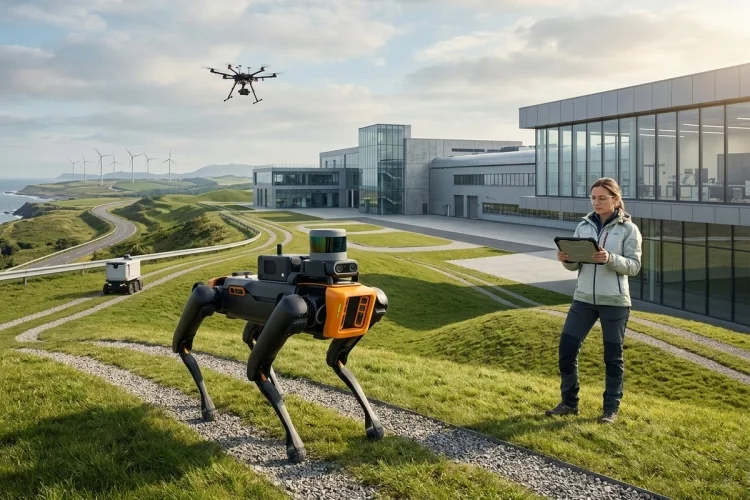
When you hear the word “robot,” you may picture a shiny humanoid machine walking, talking, and behaving like a person. Robots in the real world, however, often look very different from their movie versions.
A robotic arm assembling cars, a small vacuum moving around a living room, and a rover exploring another planet can all be considered robots. Some are controlled directly by people, while others can complete parts of their work automatically.
So, what is a robot, exactly?
A robot is a programmable machine designed to perform physical tasks by interacting with its surroundings. It may use sensors to collect information, a controller to process that information, and motors or other mechanisms to move and act.
Robotics is the field concerned with designing, building, programming, operating, and improving these machines. It brings together mechanical engineering, electronics, computer science, control systems, and sometimes artificial intelligence.
What Makes a Machine a Robot?
Not every machine is a robot. A traditional electric fan, for example, performs a physical action, but it usually follows a simple fixed command without sensing or responding meaningfully to its environment.
A robot normally combines programmability with physical action. It can be instructed to move, pick up an object, inspect an area, or perform another task in the real world.
Many robots can also respond to changing conditions. A warehouse robot might slow down when a person crosses its path, while a robotic vacuum may change direction after detecting a wall.
The exact definition varies depending on the industry and technical standard.
ISO 8373 provides standardized robotics vocabulary, while OSHA describes industrial robots as programmable, multifunctional mechanical devices that move materials, parts, tools, or specialized equipment through programmed motions.
How Does a Robot Work?
Most robots operate through a basic cycle often described as sense, process, and act.
First, the robot gathers information through sensors. Cameras can detect objects, microphones collect sound, and distance sensors measure how close the robot is to an obstacle. Other devices may measure pressure, temperature, speed, force, or location.
The robot’s controller then processes the information. The controller may be a small embedded computer, an industrial control system, or a more powerful onboard processor running specialized software.
Finally, the robot acts. It may turn a wheel, move an arm, close a gripper, activate a tool, or send information to a human operator.
Consider a self-driving robotic rover. Its sensors identify obstacles, its software calculates a safe direction, and its motors move the wheels.
NASA’s educational robotics projects use this same general idea when teaching students to program rovers to navigate obstacles and operate robotic arms.
What Are the Essential Parts of a Robot?
A robot’s design depends on its purpose, but most robotic systems contain several basic components.
The mechanical structure forms the robot’s body. It might be an arm with rotating joints, a wheeled platform, a flying drone, or a machine shaped for underwater exploration.
Sensors provide information about the robot and its environment. Without them, a machine may follow commands but cannot easily react when conditions change.
Actuators create movement. Electric motors are common, but some robots use hydraulic or pneumatic systems when greater force is required.
The controller acts as the robot’s operational brain. It runs the instructions, interprets sensor data, and sends commands to the actuators.
Many robots also have an end effector, meaning the device attached to the end of a robotic arm. This could be a gripper, welding tool, camera, drill, spray nozzle, or another specialized device.
A complete industrial robot system may include the robot, end effector, control software, power sources, sensors, communication equipment, and surrounding safety systems.
What Are the Main Types of Robots?
Robots can be classified according to where they work, how they move, and what tasks they perform.
1. Industrial Robots
Industrial robots are commonly found in factories. Robotic arms can weld metal, paint surfaces, move heavy materials, assemble products, or load machines.
Their speed and accuracy make them useful for repetitive production tasks. The International Federation of Robotics reported that 542,000 industrial robots were installed worldwide in 2024, more than double the annual number recorded ten years earlier.
2. Service Robots
Service robots perform useful tasks outside traditional industrial production. Examples include cleaning robots, delivery machines, surgical systems, agricultural robots, and devices that assist people with limited mobility.
Some service robots work in professional environments, while others are designed for personal or household use. ISO has developed specific safety requirements for personal and professional service robots.
3. Mobile and Exploration Robots
Mobile robots travel through an environment using wheels, tracks, legs, propellers, or other methods. Warehouse vehicles, drones, autonomous delivery machines, and planetary rovers belong to this broad category.
Robots are especially useful for space exploration because they can enter environments that are distant, dangerous, or impossible for humans to visit safely.
NASA research has explored robotic navigation, obstacle avoidance, sample collection, construction, and human-robot collaboration for missions beyond Earth.
4. Collaborative and Humanoid Robots
Collaborative robots, often called cobots, are designed for applications in which robotic systems and humans share a workspace. Safe collaboration requires careful risk assessment, speed control, monitoring, and system design.
Humanoid robots have bodies or movement patterns inspired by people. They may have arms, legs, hands, or faces, but a machine does not need to look human to qualify as a robot.
Are Robots and Artificial Intelligence the Same?
Robotics and artificial intelligence are related, but they are not identical.
Robotics focuses mainly on machines that interact physically with the real world. Artificial intelligence focuses on computer systems that perform tasks involving prediction, language, perception, planning, or decision-making.
A robot does not always need AI. A factory arm can repeat exactly the same programmed movement thousands of times without learning anything.
Similarly, AI does not always need a robot. A chatbot, recommendation engine, or fraud-detection system can operate entirely as software.
When the two technologies are combined, AI can help robots recognize objects, interpret spoken instructions, plan movements, and adapt to unfamiliar conditions.
Newer robotics research is exploring models that allow machines to use visual information, reason about tasks, and interact more naturally with people.
Where Are Robots Used Today?
Manufacturing remains one of the biggest areas of robotic use. Robots perform welding, painting, assembly, packaging, inspection, and material-handling tasks that demand consistency or involve unpleasant conditions.
Healthcare robots may assist with surgery, rehabilitation, hospital logistics, and laboratory work. Agricultural machines can monitor crops, remove weeds, spray plants, or harvest certain foods.
Warehouses use mobile robots to transport goods, while emergency teams may deploy machines in dangerous locations. Underwater robots inspect pipelines and study the ocean, and space robots explore planets, moons, and other distant environments.
Robots are often selected for work that is highly repetitive, physically demanding, hazardous, or difficult to perform accurately. OSHA notes that industrial robots are commonly used for material handling, assembly, welding, painting, and machine-loading operations.
What Are the Benefits and Challenges of Robotics?
Robots can perform repetitive tasks consistently, lift heavy objects, and enter places that may be unsafe for people. They can also operate with high precision and continue working for long periods when properly maintained.
However, robots are not automatically cheaper, safer, or more reliable than human workers. Purchasing, programming, integrating, and maintaining a robotic system can require significant investment and technical expertise.
Safety is another major concern. A fast-moving industrial robot can cause serious harm when safeguards fail or someone enters its operating area unexpectedly.
Modern safety standards address robot design, installation, system integration, emergency stopping, protective equipment, and human-robot interaction.
OSHA stresses that identifying hazards is only the beginning; workplaces must also establish and follow effective control measures.
How Can a Beginner Start Learning Robotics?
You do not need an advanced laboratory to begin learning robotics. A small educational kit can introduce programming, motors, sensors, circuits, and mechanical design.
Start by learning how a simple program controls an output. You might program a wheeled robot to move forward, stop before an obstacle, and turn toward an open path.
From there, explore basic electronics, Python or another beginner-friendly programming language, computer-aided design, and control systems. Small projects are usually more helpful than trying to build a complicated humanoid machine immediately.
Robotics is a multidisciplinary field, so making mistakes is part of the learning process. Every wiring problem, programming error, or failed movement teaches you something about how physical machines and software work together.
A robot is a programmable machine that performs physical tasks by sensing its environment, processing information, and taking action.
Robots come in many forms, including industrial arms, household devices, warehouse vehicles, drones, medical systems, and planetary rovers.
Robotics combines mechanical engineering, electronics, software, sensors, and control technology. Artificial intelligence can make a robot more adaptable, but not every robot uses AI, and not every AI system has a physical body.
Begin exploring robotics with a simple project involving sensors and movement.
Learning how a small robot detects an obstacle and changes direction is an excellent first step toward understanding the machines transforming factories, hospitals, homes, farms, and space exploration.