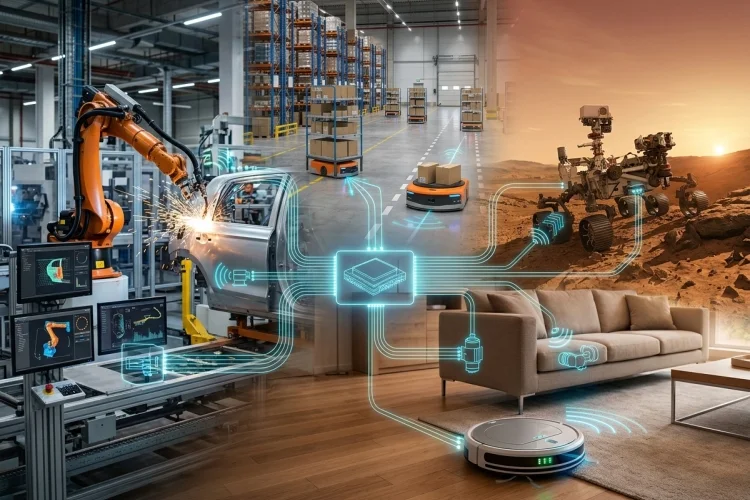
A robot can weld a car door, carry packages through a warehouse, clean a living room, or explore the surface of Mars. These machines may look completely different, but they rely on many of the same basic principles.
So, how do robots work?
Most robots follow a simple cycle: they collect information, process it, and perform a physical action. Sensors gather details about the robot and its surroundings.
A controller runs software that decides what should happen next, while motors and other moving components carry out the command.
Some robots repeat carefully programmed movements. Others can avoid obstacles, adjust their grip, or choose a route based on changing conditions. A few use artificial intelligence to recognize objects and handle more complicated situations.
Understanding this process does not require an engineering degree. Once you know how sensing, computing, movement, power, and feedback work together, even an advanced robotic system becomes much easier to understand.
The Basic Robot Cycle: Sense, Process, and Act
The easiest way to understand a robot is to divide its operation into three stages: sensing, processing, and acting.
First, sensors collect information. A mobile robot might measure the distance to a wall, while a factory arm may detect the position and weight of an object.
Next, the robot’s controller processes that information according to its programming. It may decide to stop, turn, move an arm, or activate a tool.
Finally, actuators create physical action. Motors may rotate wheels, move joints, close a gripper, or lift a mechanical arm.
This cycle can happen many times per second. By constantly reading new information and adjusting its actions, a robot can respond to changes rather than blindly repeating one movement.
Robot-control software often follows a similar read-update-write cycle: read data from sensors, update the robot’s state and commands, and write instructions to its hardware.
Sensors Help Robots Understand Their Surroundings
A robot cannot see, hear, or feel exactly like a human, so it depends on electronic sensors.
Cameras allow robots to capture visual information. Computer-vision software can then identify objects, estimate distances, read labels, or locate people.
Distance sensors use technologies such as ultrasonic waves, infrared light, radar, or LiDAR. A robotic vacuum can use these measurements to detect furniture and avoid falling down stairs.
Other sensors measure force, pressure, speed, temperature, balance, acceleration, and joint position. An encoder, for example, tracks how far a motor or wheel has rotated.
NASA’s rover systems combine cameras, inertial measurement units, motor encoders, and other sensors to estimate location and move across difficult terrain. JPL’s rover simulations also model interactions among motors, cameras, sensors, wheels, and the ground.
Sensors do not automatically tell a robot what something means. They produce raw data, and the machine’s software must interpret that information before it can respond.
Controllers and Software Make the Decisions
The controller is often described as the robot’s brain, although it does not think like a human brain.
It may be a small microcontroller, an industrial computer, or a powerful onboard processing system. The controller receives sensor readings and runs instructions that determine what the robot should do.
A simple line-following robot might use a basic rule: when the sensor detects that the machine is moving away from the line, adjust the wheel speeds. An industrial robot may follow a longer program describing the position, speed, and timing of every joint.
More advanced systems divide their software into separate components. One component may process camera images, another plans a route, and another controls the motors.
The Robot Operating System, commonly called ROS, provides software libraries and tools that help developers connect these different parts of a robotic application. It can manage communication among sensors, controllers, planning programs, and other components.
Before testing software on an expensive physical machine, engineers can also use simulation. A virtual environment allows them to model the robot, its sensors, actuators, and surroundings without risking damage to real equipment.
Actuators Turn Commands into Physical Movement
An actuator converts energy and computer commands into physical action.
Electric motors are among the most common robotic actuators. They can turn wheels, rotate joints, move conveyor systems, or operate small mechanical tools.
Large industrial machines may use hydraulic actuators when they need greater force. Pneumatic systems, which use compressed air, are useful for quick and relatively simple movements.
A robotic arm usually contains several joints. Each joint provides a particular type of movement, such as rotating, bending, or extending.
The number of independent movements a robot can make is described as its degrees of freedom. A simple arm may only move up and down, while a six-axis industrial robot can position and rotate a tool in several directions.
At the end of the arm is an end effector. This may be a gripper, welding device, drill, camera, suction cup, paint sprayer, or another tool selected for the robot’s job.
OSHA describes industrial robots as programmable, multifunctional mechanical devices that move materials, tools, parts, or specialized equipment through programmed motions.
Feedback Loops Keep Robots Accurate
Robots rarely perform perfectly by sending one command and hoping for the best. They use feedback to check whether the expected movement actually happened.
Suppose a controller tells a motor to rotate a wheel by a certain amount. An encoder measures the real rotation and reports it to the controller.
When the wheel has not moved far enough, the controller can provide more power. When it moves too far, the system can slow or reverse it.
This creates a closed-loop control system. The robot performs an action, measures the result, compares it with the target, and makes a correction.
Feedback is especially important when a robot handles fragile or unpredictable objects. A robotic gripper may use force sensors to hold a glass firmly enough to lift it without squeezing hard enough to break it.
However, feedback systems have limitations. Sensor noise, worn components, slippery surfaces, and unexpected obstacles can all reduce accuracy. Engineers must test how the machine responds when real conditions differ from its ideal program.
Robots Need Power and Communication
Every robot needs an energy source. Stationary industrial machines are often connected directly to electrical power, while mobile robots usually rely on batteries.
Power management affects how long a robot can operate, how much weight it can carry, and how powerful its motors can be. Designers must balance performance against battery size, charging time, heat, and total weight.
Space robots face even stricter limitations. NASA’s Perseverance rover contains wheels, computers, scientific instruments, communication systems, and a robotic arm, all of which require carefully managed power.
Robots may also need to communicate with other machines or human operators. Factory systems exchange information through wired or wireless networks, while remote exploration robots receive commands and transmit data over long distances.
Communication delays can affect control. Because Mars is millions of kilometers away, engineers cannot operate a rover as though it were a remote-controlled car sitting nearby. The rover needs enough onboard programming to perform parts of its mission independently.
How Automation and AI Change Robot Behavior
Not every robot uses artificial intelligence. Many factory robots simply repeat movements that have been programmed and tested in advance.
A remotely operated robot also depends heavily on a human operator. The person may control its movement using a joystick, computer, or specialized control station.
An autonomous robot can complete at least part of a task without continuous human control. It may plan a route, avoid obstacles, or return to a charging station automatically.
Artificial intelligence can make autonomy more flexible. Machine-learning models may help robots recognize objects, interpret spoken instructions, predict movement, or adjust to situations they did not encounter in exactly the same form during programming.
However, AI does not remove the need for traditional robotics. Even an intelligent machine still requires reliable sensors, mechanical structures, power systems, actuators, control software, and safety mechanisms.
Robots are becoming increasingly common in manufacturing. The International Federation of Robotics reported that approximately 542,000 industrial robots were installed worldwide in 2024, while the global operational stock reached about 4.66 million units.
As robotic systems become more capable, safety remains essential. OSHA notes that many accidents happen during non-routine activities such as setup, programming, testing, maintenance, and adjustment, when workers may enter the robot’s operating area.
Robots work by combining sensors, controllers, software, actuators, power systems, and feedback loops. Sensors collect information, the controller decides what to do, and actuators turn those decisions into physical movement.
Some machines follow fixed programs, while autonomous robots can adapt their actions as conditions change. Artificial intelligence may improve object recognition, navigation, and planning, but it is only one part of a complete robotic system.
A great way to understand robotics is to start with a small project. Try programming a simple robot to move, detect an obstacle, and change direction.
Watching the sense-process-act cycle happen in front of you makes the technology behind factory arms, household robots, and planetary rovers much easier to appreciate.