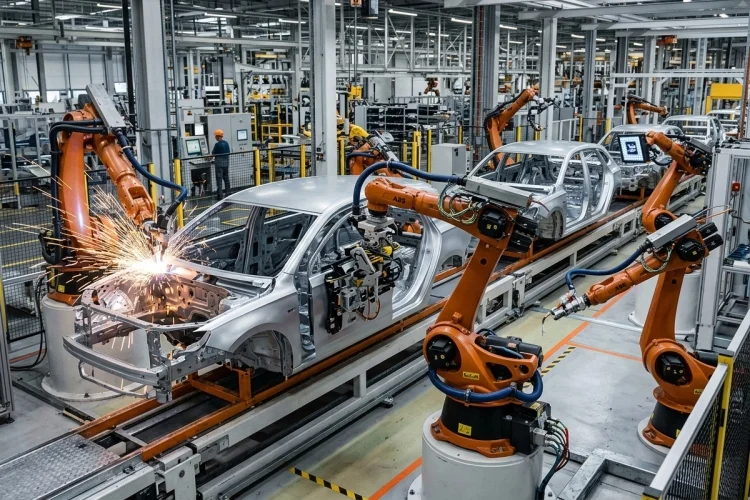
Picture a modern assembly line. Car bodies move between workstations while robotic arms weld metal, install components, apply adhesive, and inspect finished surfaces.
The movements look smooth and almost effortless, but every action depends on carefully coordinated hardware and software.
So, how do robots work on modern assembly lines?
Most factory robots follow programmed instructions while receiving information from sensors, cameras, and production equipment.
A controller calculates where the robot should move, actuators power its joints, and an end effector performs the actual job. That tool could be a gripper, welding torch, screwdriver, suction cup, or inspection camera.
Modern manufacturing robots are also becoming more flexible. Machine vision helps them locate parts, force sensors allow them to handle delicate components, and factory networks help multiple machines work together.
This technology is already widely used. The International Federation of Robotics reported that 542,000 industrial robots were installed worldwide in 2024, taking the global operational stock to approximately 4.66 million units.
What Is an Assembly Line Robot?
An assembly line robot is a programmable industrial machine that performs one or more production tasks. It may move parts, join components, operate tools, inspect products, or transfer materials between workstations.
The most familiar design is the articulated robotic arm. Its rotating joints allow it to reach different positions and approach a component from several angles.
The tool attached to the end of the arm is called an end effector. Manufacturers can change this tool depending on the job. A gripper picks up components, a welding torch joins metal, and a powered screwdriver installs fasteners.
An industrial robot system includes more than the arm itself. OSHA explains that the complete setup may include controllers, software, sensors, power sources, communication interfaces, and specialized end effectors.
Robots Follow a Sense-Process-Act Cycle
Assembly line robots operate through a repeating cycle of sensing, processing, and acting.
Sensors first collect information about the robot and its surroundings. They may detect the arrival of a component, measure the position of a joint, or confirm that a part has been placed correctly.
The robot’s controller processes that information and compares it with the programmed production sequence. It then sends commands to the motors controlling the robot’s joints.
Finally, the robot performs an action. It may rotate toward a conveyor, lower its arm, close a gripper, lift a component, and place it inside a product.
This cycle can happen many times per second. Feedback from the sensors allows the controller to correct small positioning errors instead of assuming that every movement happened perfectly.
Assembly lines also use programmable logic controllers, commonly called PLCs, to coordinate robots with conveyors, safety gates, tools, and other machinery. The PLC might tell a conveyor to stop, confirm that a product is in position, and then signal the robot to begin its task.
Machine Vision Helps Robots Find and Inspect Parts
Traditional industrial robots work best when every component arrives in exactly the same position. Modern assembly lines use machine vision to handle more variation.
A camera captures an image of the workspace, and vision software identifies the component’s position and orientation. The controller then calculates how the robot should approach it.
This makes applications such as random bin picking possible. Instead of placing every part into a specially designed holder, workers can supply a container of mixed or loosely arranged components.
A vision-guided robot identifies a suitable part and plans how to pick it up. Machine vision is also used for quality control.
Cameras can inspect labels, read barcodes, measure dimensions, check alignment, and look for visible defects. NIST lists robot guidance, seal and label inspection, measurement, and automated visual inspection among common manufacturing uses.
However, cameras are not perfect. Reflections, shadows, transparent materials, flexible parts, and unusual surfaces can make objects difficult to recognize. NIST research highlights these conditions as continuing challenges for robotic perception systems.
Different Robots Handle Different Assembly Tasks
No single robot design is ideal for every production process.
Articulated six-axis robots are highly flexible and commonly used for welding, painting, machine tending, and complicated assembly movements. Their joints allow them to position a tool from many directions.
SCARA robots are often used for fast horizontal assembly, such as placing electronic parts or inserting components. Delta robots use lightweight arms connected above the workspace, making them suitable for rapid picking and packaging.
Cartesian robots move along straight axes. Their simple structure can provide accurate movement for dispensing, cutting, loading, and material handling.
Autonomous mobile robots move materials between production areas. Unlike fixed conveyors, they can travel along flexible routes and adjust when the factory layout or production schedule changes.
The right choice depends on the required payload, reach, speed, accuracy, working environment, and type of end effector. A robot that moves heavy vehicle parts has very different requirements from one that handles tiny electronic components.
Force Control Makes Assembly More Precise
Some assembly operations require more than accurate positioning. The robot must also control how much pressure it applies.
Imagine inserting a small connector into a socket. A minor alignment error could bend the pins or damage the component. Force and torque sensors allow the robot to detect resistance and adjust its movement.
The same approach can be used for polishing, sanding, tightening screws, and fitting parts together. Instead of following a completely rigid path, the robot responds to physical contact.
NIST research on force-controlled assembly describes force sensing and related algorithms as important technologies for mechanical assembly applications. These capabilities help robots complete operations involving contact, alignment, and changing resistance.
Precision still depends on good system design. The robot, tool, fixtures, sensors, and components must all be calibrated correctly. A highly accurate robot cannot compensate for a loose gripper or badly positioned workstation.
Robots Communicate Across the Smart Factory
A modern assembly robot rarely works alone. It exchanges information with conveyors, inspection systems, production software, and other machines.
Suppose a product fails an automated inspection. The quality-control system can record the defect, remove the product from the line, and notify operators. The manufacturer can then study the data to identify whether a tool, component, or production setting caused the problem.
Connected sensors also help monitor equipment condition. Changes in motor temperature, vibration, power use, or cycle time may indicate that maintenance is needed.
This approach is often called predictive maintenance. Instead of waiting for a machine to fail, the manufacturer uses operational data to schedule service before a serious breakdown occurs.
Artificial intelligence is adding more adaptability. NIST notes that AI-supported assembly robots can handle greater variation in parts and product types, while autonomous material-handling robots can use computer vision and path planning to navigate factory floors.
The goal is not simply to make individual robots faster. It is to create a connected production system that can respond efficiently to changing orders, equipment conditions, and quality requirements.
Collaborative Robots Work Near People
Traditional industrial robots are often separated from employees by fences, locked doors, and safety sensors. Collaborative robots, or cobots, are designed for applications where people and robotic systems work more closely together.
A cobot might hold a heavy component while a worker installs smaller parts. It could also handle repetitive loading while the employee performs inspection and problem-solving.
These machines may include speed limits, force monitoring, proximity sensors, and safety-rated stopping functions. However, calling a robot “collaborative” does not automatically make every application safe.
A cobot carrying a sharp tool or heavy object can still cause harm. The tool, workspace, product, speed, and possible human contact must all be included in the risk assessment.
The updated ISO 10218 standards provide safety requirements for industrial robots and their integration into robotic applications and cells.
Safety Systems Protect Assembly Line Workers
Robots can reduce human exposure to heavy lifting, welding fumes, hot materials, sharp tools, and repetitive movements. At the same time, their speed and strength create new risks.
Modern robotic cells may use fences, interlocked gates, emergency stops, light curtains, laser scanners, and pressure-sensitive equipment. When a person enters a restricted area, the safety system can stop or slow the machine.
Many incidents occur outside normal production. OSHA notes that workers may enter a robot’s operating area during programming, testing, setup, maintenance, or adjustment, when unexpected movement can cause injury.
Safe operation therefore requires more than reliable technology. Employees need clear procedures, proper training, lockout controls, regular inspections, and an understanding of every energy source connected to the robot.
Production targets should never encourage workers to bypass guards or restart equipment before confirming that the area is safe.
Robots on modern assembly lines work by combining programmed instructions, sensors, controllers, actuators, machine vision, and specialized end effectors.
They can pick up components, perform precise assembly, inspect products, and communicate with other factory systems.
Force control helps robots manage physical contact, while smart-factory data supports quality tracking and predictive maintenance. Cobots also create new opportunities for people and machines to share tasks, although careful safety planning remains essential.
The next time you watch an automated production line, look beyond the moving robot arms. Notice how conveyors, cameras, tools, sensors, and employees work as one coordinated system.
Exploring these connections is the best way to understand how modern manufacturing automation really works.