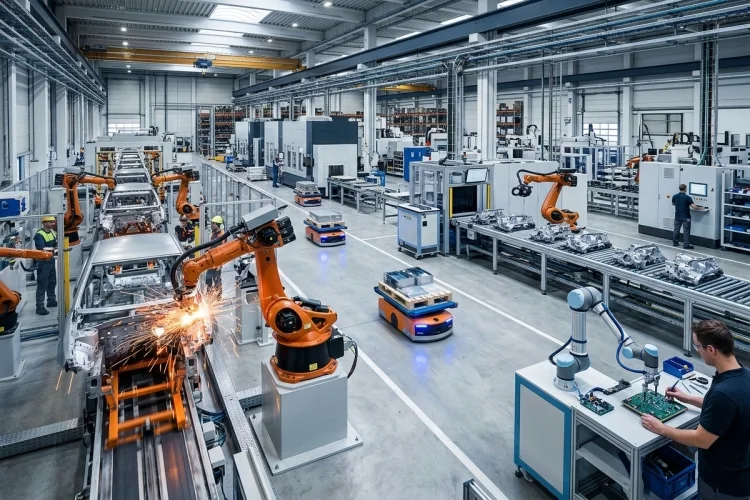
Walk into a modern factory, and you may see robotic arms welding car bodies, machines placing tiny electronic parts, or mobile robots carrying materials across the production floor.
These systems can work quickly and repeatedly without getting tired or losing concentration. However, industrial robotics is no longer limited to giant automotive factories.
Smaller manufacturers are beginning to use compact robotic arms, collaborative robots, machine vision, and autonomous vehicles for tasks that once required expensive custom equipment.
So, how are industrial robots changing manufacturing?
They are helping companies produce goods faster, improve consistency, reduce workplace hazards, and respond more quickly to changes in customer demand.
When combined with artificial intelligence, sensors, and connected factory systems, robots can also inspect products, predict maintenance needs, and adapt to variations in materials.
The International Federation of Robotics reported that 542,000 industrial robots were installed worldwide in 2024. The global operational stock reached approximately 4.66 million units, showing how deeply robotics has entered modern production.
What Are Industrial Robots?
An industrial robot is a programmable machine designed to move materials, tools, components, or specialized equipment through controlled motions.
Robotic arms are the most recognizable example. They usually have several joints that allow them to rotate, bend, extend, and position tools with high precision.
A tool attached to the end of the arm is called an end effector. Depending on the task, it may be a gripper, welding torch, drill, suction cup, paint sprayer, or inspection camera.
Industrial robots are commonly used for material handling, assembly, welding, painting, spraying, packaging, and loading or unloading machinery. They are especially useful for work that is repetitive, physically demanding, hazardous, or difficult to perform consistently.
Not every industrial robot operates independently. Some repeat fixed movements, while more advanced systems use cameras, sensors, and intelligent software to respond to changing conditions.
Robots Make Production Faster and More Consistent
One of the biggest advantages of industrial automation is consistency.
A human worker may naturally become tired after performing the same movement hundreds of times. A correctly programmed robot can repeat that movement with nearly identical speed and positioning throughout a production shift.
This repeatability is valuable in processes such as welding, painting, cutting, and component placement. Small differences can affect product quality, create waste, or cause problems later in the assembly process.
Robots can also reduce cycle times. A machine may move quickly between several programmed positions while coordinating with conveyors, sensors, and other equipment.
That does not mean a robot can simply be installed and immediately increase productivity. The entire workflow must be designed carefully.
Poorly organized materials, slow upstream equipment, or frequent programming problems can leave an expensive robot waiting without producing anything.
Manufacturers therefore need to measure the complete process rather than focusing only on the speed of the robotic arm.
Automation Is Improving Product Quality
Industrial robots can improve quality by controlling movement, speed, pressure, and positioning more consistently than many manual processes.
In welding, for example, a robot can follow a programmed path while maintaining a controlled speed and angle. In painting, it can apply a more uniform coating and reduce unnecessary material use.
Robots can also work with machine-vision systems. Cameras capture images of products, while software checks dimensions, surface conditions, labels, alignment, or visible defects.
AI-powered vision can identify subtle anomalies and support faster inspections across a production line. It can also help manufacturers track inventory and detect safety issues on the factory floor.
However, automated inspection is not automatically perfect. A vision system trained or configured under ideal lighting may perform poorly when shadows, reflections, dust, or product variations appear.
Manufacturers still need regular calibration, testing, and human review. Automation improves quality only when the system is designed around realistic production conditions.
Robots Can Make Dangerous Work Safer
Factories often contain heavy materials, hot surfaces, sharp tools, toxic substances, and fast-moving machinery.
Industrial robots can perform tasks that would expose people to these hazards. They may handle molten material, spray chemicals, lift heavy parts, or work close to welding sparks and extreme temperatures.
This does not eliminate workplace risk. It changes where and when the danger appears.
OSHA notes that many robot-related accidents occur during non-routine activities such as maintenance, programming, testing, setup, and adjustment. Workers may enter the robot’s operating area while the machine is still capable of unexpected movement.
Effective safety therefore requires more than placing a fence around a robot. Manufacturers need risk assessments, machine guarding, emergency stops, controlled access, clear procedures, and proper employee training.
Collaborative robots, commonly called cobots, are designed for applications in which people and robotic systems share a workspace. They may use force limits, speed monitoring, cameras, or proximity sensors to reduce risk.
Even so, the complete application must be evaluated. A cobot carrying a sharp or heavy object can still be dangerous, regardless of how safely the arm itself was designed.
Smart Factories Are Making Robots More Flexible
Traditional factory robots work extremely well when products arrive in the same position and the task rarely changes. They become less effective when objects vary in shape, orientation, or size.
Modern sensors and artificial intelligence are helping robots manage more variation.
A vision-guided robot can identify the location of a randomly positioned component rather than requiring every part to arrive in a fixed holder. AI-powered assembly systems may also adjust to different product models or changing component types.
Mobile robots are transforming material movement as well. Instead of following a permanently installed conveyor, autonomous mobile robots can navigate the factory, avoid obstacles, and deliver components to different workstations.
Connected robots are also becoming part of the broader Industry 4.0 model. In a smart factory, robotics can operate alongside Internet of Things sensors, artificial intelligence, autonomous systems, and data analytics.
These technologies can help shorten cycle times, reduce downtime, improve equipment effectiveness, and support more informed production decisions.
The result is a factory that can respond more quickly when demand, product design, or production schedules change.
Industrial Robots Are Changing Manufacturing Jobs
The spread of robotics has created understandable concerns about employment. Some routine production tasks can be reduced or automated when robots are introduced.
However, manufacturing work does not simply disappear. It often changes.
A worker who previously loaded parts into a machine may begin monitoring a robotic cell, checking product quality, preparing materials, or resolving exceptions. Factories also need technicians who can program, maintain, calibrate, and troubleshoot automated equipment.
Demand is therefore growing for skills involving robotics, industrial networking, data analysis, cybersecurity, electrical systems, and machine maintenance.
In the World Economic Forum’s 2025 survey, 58% of employers expected robotics and automation to transform their businesses by 2030. The report also found growing demand for technological literacy alongside human abilities such as flexibility and problem-solving.
The strongest manufacturing teams will probably combine machine efficiency with human judgment. Robots are excellent at repetition, precision, and heavy lifting, while people remain essential for creativity, communication, unexpected problems, and responsibility.
Smaller Manufacturers Can Adopt Robotics Gradually
Industrial robotics was once associated mainly with large companies producing enormous volumes of identical goods. High equipment costs and complicated integration made automation difficult for smaller manufacturers.
Those barriers have not disappeared, but robotic systems are becoming easier to program, reuse, and combine with existing equipment.
Compact robots and cobots can be suitable for machine loading, packaging, inspection, simple assembly, and other focused applications. A small manufacturer does not need to automate the entire factory at once.
A better approach is to begin with a well-defined bottleneck. The company can identify a repetitive task, calculate its current cost, evaluate safety concerns, and estimate how often the product or process will change.
Integration remains a major challenge. NIST highlights the need for better performance measurement, interoperability, agility, and easier deployment—especially for small and medium-sized manufacturers.
A successful robotics project must consider tooling, floor space, maintenance, training, safety, software, and the equipment surrounding the robot. The robotic arm is only one part of the total system.
The Future of Industrial Robotics
Industrial robots are likely to become more adaptable, connected, and easier to use.
Programming may increasingly involve demonstrations, visual interfaces, or natural-language instructions rather than long sequences of specialized code. Better sensors will help robots recognize objects and understand what is happening around them.
Artificial intelligence may also improve grasping, inspection, route planning, predictive maintenance, and coordination among several machines.
The long-term growth trend remains strong. IFR reported that annual industrial robot installations exceeded 500,000 units for four consecutive years through 2024 and projected continued global growth.
Still, the future is not simply about placing more robots in factories. The real goal is to design production systems in which machines, software, and skilled employees work together effectively.
Industrial robots are changing manufacturing by increasing production speed, improving consistency, reducing exposure to dangerous work, and enabling more flexible factory operations.
Machine vision, artificial intelligence, and connected systems are making these machines more capable than earlier generations of fixed automation.
However, robotics is not a simple replacement for human labor. Successful adoption requires careful planning, safety controls, employee training, maintenance, and reliable integration with the rest of the production process.
Manufacturers should begin by identifying one clear problem rather than automating everything at once. Workers can prepare by developing skills in robotics, maintenance, data, and problem-solving.
The factories that benefit most will be those that combine robotic precision with human experience and judgment.