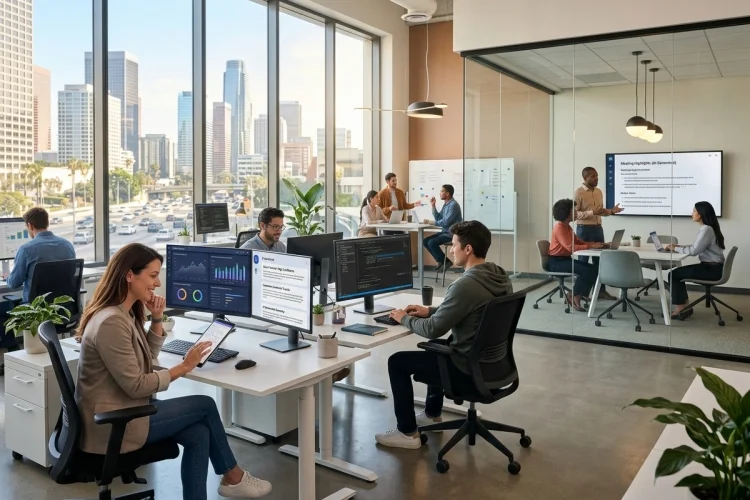
Artificial intelligence is no longer something that only technology companies use. It is already helping office workers summarize reports, developers write code, retailers forecast demand, and customer-service teams answer routine questions.
In many workplaces, the biggest change is not a robot suddenly taking someone’s desk. It is a collection of smaller changes happening inside familiar software.
Email applications suggest replies, meeting tools create notes, and business platforms analyze information that once took employees hours to review. This explains why conversations about how artificial intelligence is changing the workplace can feel both exciting and uncomfortable.
AI can reduce repetitive work and make useful knowledge easier to access. At the same time, it can reshape job responsibilities, create new skill requirements, and raise serious questions about privacy, fairness, and job security.
The workplace of the future will probably not be completely automated. It is more likely to be built around collaboration between people and machines, with each handling the tasks it does best.
AI Is Automating Routine Tasks
One of AI’s clearest workplace roles is handling repetitive, time-consuming activities. Employees can use AI-powered systems to organize documents, classify support tickets, extract information from invoices, schedule appointments, and prepare basic reports.
A customer-service team, for example, may use a chatbot to answer common questions about delivery times or password resets. Human representatives can then spend more time dealing with unusual cases, frustrated customers, or problems that require judgment.
Generative AI is expanding this form of automation into knowledge work. It can draft an email, turn meeting notes into a summary, create a presentation outline, or rewrite technical information in simpler language.
The goal should not always be to remove the employee from the process. In many cases, the best result comes from using AI to produce a first draft and allowing a person to review, correct, and improve it.
AI Is Becoming a Workplace Copilot
Traditional automation usually follows fixed instructions. Newer AI assistants are more flexible because employees can communicate with them using ordinary language.
A marketing professional might ask an AI tool to suggest campaign ideas for a particular audience. A programmer may request an explanation of unfamiliar code, while an HR employee could use it to organize information from a long policy document.
These tools act more like copilots than independent workers. They can generate options quickly, but the employee still decides which suggestions are useful.
AI adoption has already become widespread. Stanford’s 2026 AI Index reported that 88% of surveyed organizations used AI in 2025, while 70% used generative AI in at least one business function. However, the use of fully autonomous AI agents remained limited across most functions.
This suggests that most companies are still using AI to support human work rather than allowing systems to operate without supervision.
Faster Decisions Do Not Always Mean Better Decisions
AI can analyze large amounts of data much faster than a person. Businesses use predictive models to forecast sales, detect unusual transactions, estimate equipment failures, and identify changes in customer behavior.
A retailer might combine previous sales, seasonal trends, and inventory data to estimate how much stock will be needed. A manufacturer can analyze sensor readings to predict when a machine may require maintenance.
These systems can help employees notice patterns they might otherwise miss. Still, an AI prediction is not the same as a guaranteed outcome.
A model may produce poor results when its data is inaccurate, outdated, or unrepresentative. It can also overlook context that experienced employees understand immediately.
For that reason, AI should support decisions rather than automatically control every important choice. Human review is particularly necessary when decisions affect employment, healthcare, finance, safety, or legal rights.
Jobs Are Being Redesigned, Not Simply Deleted
The effect of AI on employment is more complicated than the idea that machines will replace everyone.
Some tasks will be automated, particularly predictable administrative work. Other roles will expand because employees can complete more work or offer new services with AI assistance.
The International Labour Organization estimated in 2025 that one in four workers worldwide was employed in an occupation with some exposure to generative AI. However, the organization concluded that job transformation was more likely than complete replacement in most cases.
A graphic designer may spend less time creating simple variations and more time developing original concepts. An accountant might automate data entry while focusing more on interpretation, planning, and client communication.
The OECD found a similar pattern among small and medium-sized businesses. In its survey, 83% of SMEs using generative AI reported no change in their overall staffing needs, while 65% said the technology improved employee performance.
The larger trend is therefore job redesign. Positions are being divided into tasks that AI can assist with and responsibilities that still require people.
Workplace Skills Are Changing
As AI handles more routine activities, human abilities such as critical thinking, communication, creativity, leadership, and ethical judgment become increasingly valuable.
Employees also need basic AI literacy. This does not mean everyone must become a machine-learning engineer. It means workers should understand what AI can do, where it fails, and how to review its outputs.
Prompt writing may become a useful skill, but it is only one small part of working with AI. Employees must also know how to protect confidential information, identify hallucinations, check sources, and recognize biased recommendations.
The World Economic Forum expects AI and big data, cybersecurity, and technological literacy to be among the fastest-growing skill areas through 2030. Its 2025 report also estimated that 39% of workers’ current skills may change or become outdated between 2025 and 2030.
Continuous learning is becoming part of almost every career. Workers who combine industry expertise with practical AI knowledge will often be more valuable than people who understand only the technology.
AI Is Changing Management and Recruitment
Artificial intelligence is not only changing employee tasks. It is also influencing how workers are hired, scheduled, evaluated, and managed.
Recruitment tools can sort applications, identify keywords, schedule interviews, and help prepare job descriptions. Management systems may allocate shifts, track performance, forecast staffing needs, or recommend how work should be distributed.
These systems can save time, but they also create risks. A hiring model trained on biased historical data may repeat previous discrimination.
Employee-monitoring software can reduce trust when workers do not know what is being measured or how the information will be used. Algorithmic management also changes the role of managers.
OECD research indicates that managers using these systems may need stronger analytical and social skills, not fewer human abilities. They must understand automated recommendations while communicating decisions fairly to employees.
Companies should tell workers when AI is being used, what data it collects, and whether a human can review or challenge an automated decision.
The Workplace Risks Cannot Be Ignored
AI can improve productivity, but careless adoption can create new problems.
Employees may accidentally enter customer information, business strategies, or confidential documents into public AI tools. Generated content may contain invented statistics, false citations, or outdated advice.
Overreliance is another concern. When workers accept every AI suggestion without thinking, they may gradually weaken their own research, writing, or problem-solving abilities.
AI can also increase inequality between employees who receive good training and those who are expected to adapt without support. OECD research found that workers who received AI training were more likely to report improved performance and working conditions.
Responsible adoption therefore requires clear policies, secure tools, regular testing, employee participation, and human accountability.
NIST’s AI Risk Management Framework recommends that organizations govern, map, measure, and manage AI-related risks throughout a system’s lifecycle.
How Workers Can Prepare for an AI-Powered Workplace
The best response to workplace AI is neither panic nor blind enthusiasm. It is practical preparation.
Begin by identifying repetitive tasks in your role. Experiment with approved AI tools to see whether they can help with research, organization, brainstorming, or first drafts.
Then strengthen the abilities AI struggles to reproduce reliably. These include understanding complex human situations, building trust, negotiating, leading teams, making ethical judgments, and applying professional experience.
Always review AI-generated work before sending, publishing, or acting on it. Check important claims and never share sensitive information unless your employer has approved the platform and explained its data policies.
Most importantly, focus on learning how to work with AI rather than competing with it at every task. The strongest employee is likely to be someone who knows when to use automation, when to question it, and when human involvement is essential.
Artificial intelligence is changing the workplace by automating routine tasks, assisting employees, improving data analysis, and reshaping how jobs are designed. It is also creating demand for AI literacy, critical thinking, communication, and continuous learning.
The transition will bring real opportunities, but it also involves risks related to privacy, bias, monitoring, misinformation, and unequal access to training. Companies cannot solve these problems by simply purchasing new software.
Start exploring the AI tools relevant to your profession, but use them thoughtfully. Learn their strengths, test their limitations, and keep improving the human skills that technology cannot easily replace.
The future of work will depend not only on what AI can do, but on how responsibly people choose to use it.