Artificial intelligence can analyze information, recognize patterns, and make predictions.
Robots can move through the physical world, operate tools, and perform tasks that require strength or precision. When these two technologies come together, machines become much more capable.
Instead of repeating one programmed movement, an AI-powered robot may recognize unfamiliar objects, adjust to changing conditions, and choose the next action based on sensor data.
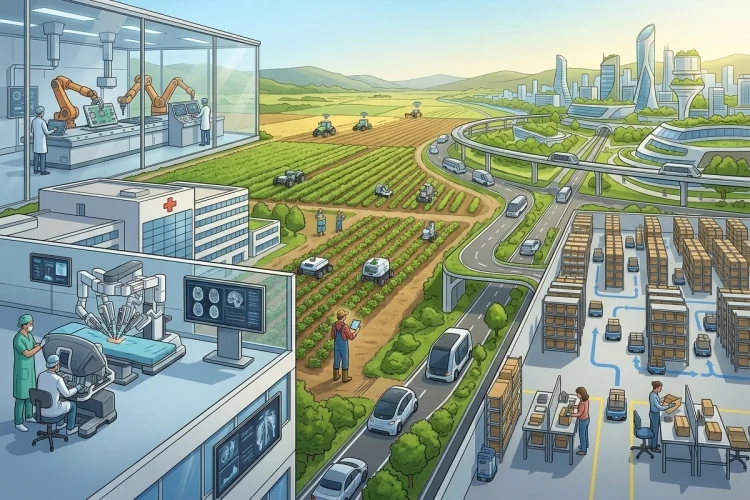
This combination is already appearing in factories, hospitals, warehouses, farms, laboratories, and space missions. So, how will artificial intelligence and robotics change the future?
The biggest transformation will probably not involve humanoid robots suddenly replacing everyone.
It will come through thousands of smaller changes: safer factories, faster medical analysis, more precise farming, smarter transportation, and machines that handle dangerous or repetitive work.
However, progress will also create questions about employment, privacy, safety, inequality, and accountability. Understanding both the opportunities and risks can help us shape a future where intelligent machines support people rather than simply replace human involvement.
How AI and Robotics Work Together
Artificial intelligence and robotics are related, but they are not the same technology.
AI mainly deals with software that can analyze data, generate content, recognize patterns, or make predictions. Robotics focuses on physical machines that sense and interact with their surroundings.
A traditional factory robot may repeat the same welding movement thousands of times without learning anything. An AI-powered robot can use cameras and machine-learning models to identify parts that arrive in different positions and adjust its movements accordingly.
The robot provides the body, including sensors, motors, mechanical joints, and tools. AI provides some of the decision-making capabilities that help the machine interpret information and respond more flexibly.
This combination is sometimes called embodied AI because intelligence is placed inside a system that can act in the physical world. As perception, language understanding, and motion planning improve, robots may become easier to instruct and quicker to adapt to new tasks.
Manufacturing Will Become More Flexible
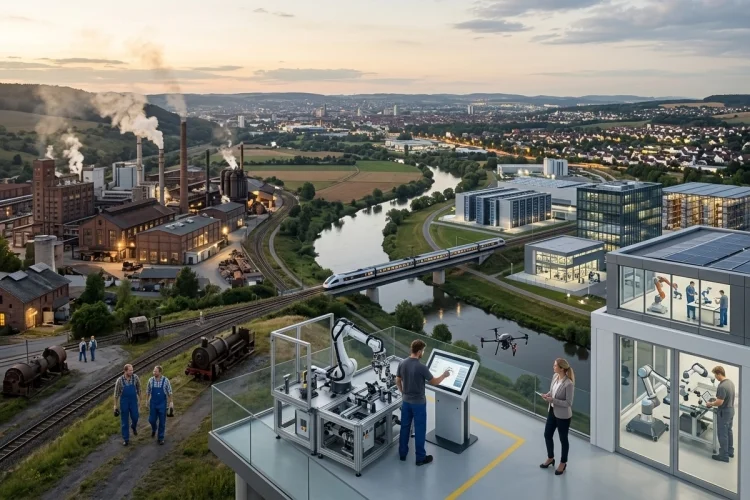
Industrial robots have already transformed automotive, electronics, metalworking, and other manufacturing industries. Their role is likely to expand as machines become easier to program and more capable of handling product variations.
The International Federation of Robotics reported that 542,000 industrial robots were installed worldwide in 2024.
Annual installations remained above 500,000 units for the fourth consecutive year, while the market value of industrial robot installations reached a record $16.7 billion.
Future factories will use AI-powered vision to inspect products, guide robotic arms, and identify unusual conditions. Connected sensors will track vibration, temperature, energy use, and production speed.
That information can support predictive maintenance. Instead of waiting for a machine to fail, manufacturers can identify warning signs and schedule repairs before a breakdown interrupts production.
NIST expects AI-based maintenance and increased robot adoption to continue helping manufacturers reduce downtime and improve accuracy.
Smaller companies may also gain access to automation through compact robots, collaborative systems, and more user-friendly programming tools. The challenge will be integrating these technologies safely and training employees to operate, maintain, and supervise them.
Jobs Will Change More Often Than They Disappear
AI and robotics will automate parts of many occupations, but an occupation is rarely made up of only one task.
A warehouse worker may spend less time carrying products and more time managing inventory exceptions. A technician may move from operating one machine manually to monitoring several automated systems.
The World Economic Forum estimates that labor-market transformation could affect 22% of today’s jobs by 2030. Its 2025 report projected 170 million new roles and 92 million displaced roles, producing a net gain of 78 million jobs under its survey-based scenario.
The International Labour Organization similarly finds that relatively few jobs consist entirely of tasks that current generative AI can automate. In most occupations, human input remains necessary, making job transformation more likely than complete replacement.
Demand may increase for robotics technicians, AI specialists, maintenance professionals, cybersecurity experts, and people who can integrate automated systems into real workplaces.
Human skills will still matter. Communication, leadership, ethical judgment, creativity, empathy, and the ability to respond to unexpected situations are difficult to reproduce reliably with machines.
Healthcare Could Become More Precise and Accessible
AI can analyze medical images, organize records, summarize research, and help healthcare professionals identify patterns in large datasets. Robots can support surgery, rehabilitation, laboratory work, hospital logistics, and care for people with limited mobility.
In the future, AI-assisted robotic systems may help surgeons perform precise procedures or allow specialists to support patients from distant locations.
Rehabilitation robots could adjust exercises according to a patient’s progress, while hospital robots may transport supplies and reduce routine physical work.
These systems should assist qualified professionals rather than make critical medical decisions without supervision. Healthcare data is sensitive, and an inaccurate recommendation can seriously affect a patient.
The World Health Organization recognizes AI’s potential to improve healthcare but emphasizes governance, ethical standards, regulation, transparency, and protection of human rights.
WHO guidance also stresses that healthcare workers and affected communities must remain central to how these systems are designed and used.
The future of medical robotics will therefore depend not only on technical performance but also on safety testing, accessibility, privacy, and public trust.
Farming May Become Smarter and More Sustainable
Agriculture faces difficult challenges, including labor shortages, changing weather, crop disease, water limitations, and the need to produce more food without unnecessarily damaging the environment.
AI-powered agricultural robots could help farmers monitor fields, remove weeds, apply chemicals more precisely, inspect crops, and harvest certain fruits or vegetables.
Drones and ground robots can collect images, while machine-learning systems analyze crop health and soil conditions.
This approach is often called precision agriculture. Instead of treating an entire field in the same way, farmers can respond to the needs of particular areas or plants.
FAO reports that AI, remote sensing, digital twins, robotics, automation, and sensor technologies are changing how agricultural systems are understood and managed.
These tools can reduce physically demanding work, limit post-harvest losses, and support more economically viable farming.
The benefits will not arrive equally, however. Small farmers may struggle with cost, internet access, technical support, and ownership of agricultural data.
Making the technology affordable and practical will be just as important as creating more advanced machines.
Robots Will Enter More Homes, Cities, and Public Spaces
Household robots are currently best known for vacuuming floors or cutting grass. Future systems may assist older adults, help people with disabilities, monitor household hazards, or perform a wider range of routine chores.
Progress will depend on better robotic manipulation. A factory robot handles predictable objects in a controlled environment, but a home contains soft clothing, fragile dishes, pets, children, narrow spaces, and constantly changing conditions.
Cities may also use intelligent machines for infrastructure inspection, waste collection, emergency response, delivery, and public transportation. Robots could enter damaged buildings, examine dangerous areas, or perform maintenance where human access is difficult.
Autonomous vehicles are another combination of AI and robotics. Cameras, radar, software, maps, and control systems work together to identify road conditions and operate the vehicle.
These applications will require strong safety standards. A robot in a public space must respond reliably to people who may behave unpredictably, including children, older adults, and individuals with disabilities.
Privacy will also matter because many mobile robots depend on cameras, microphones, location data, and environmental mapping.
Space Exploration Will Become More Autonomous
Robots are essential for exploring places that are too distant, dangerous, or expensive for humans to reach easily.
AI can help future spacecraft and planetary robots navigate, select scientific targets, manage equipment, and respond to unexpected conditions without waiting for immediate instructions from Earth.
Communication delays make autonomy especially important on distant missions. NASA’s Jet Propulsion Laboratory is developing risk-aware machine learning and autonomy systems because future missions may require robots to adapt while operating with limited communication.
NASA is also developing robotic systems for in-space servicing and long-term exploration. Robots may eventually inspect spacecraft, move equipment, prepare habitats, or perform routine tasks so astronauts can focus on scientific work.
Teams of smaller robots could cooperate rather than relying on one large machine. NASA’s CADRE project, for example, is developing multiple autonomous rovers designed to work together while exploring the Moon.
These developments could make exploration safer while extending humanity’s reach farther into the solar system.
The Future Will Bring Serious Risks
More capable machines can produce greater benefits, but they can also cause more harm when they fail or are misused.
An AI model may misinterpret sensor data, while a robot can create physical danger through unexpected movement. Connected machines can also become targets for cyberattacks.
Bias is another concern. A service robot trained with incomplete data may recognize some voices, faces, or behaviors more accurately than others.
There are also social questions. Companies could use automation primarily to reduce costs without helping employees transition into new roles. Wealthier regions may receive most of the benefits while lower-income communities face displacement or limited access.
Accountability must remain clear. When an autonomous system causes harm, organizations cannot simply blame “the algorithm.” Developers, owners, operators, and regulators must define who is responsible for testing, monitoring, and correcting the system.
The future of AI and robotics should therefore include human oversight, cybersecurity, transparent decision-making, worker consultation, safety standards, and practical ways to challenge harmful outcomes.
How People Can Prepare for the Change
Preparing for intelligent automation does not mean everyone must become a robotics engineer.
Workers can begin by learning how AI and automated systems are being introduced into their industries. They should identify which routine tasks may change and which human responsibilities will become more valuable.
Technical literacy will help. Useful areas include data analysis, digital security, robot maintenance, programming basics, and the ability to evaluate AI-generated recommendations.
People should also develop transferable human skills. Problem-solving, teamwork, adaptability, communication, and ethical judgment remain important when technology changes quickly.
Schools, businesses, and governments will need to make retraining widely available rather than expecting workers to manage the transition alone.
The OECD’s work on AI and future skills emphasizes the need to understand what machines can do so education and workforce policies can adapt in advance.
The best preparation is not competing with machines at every repetitive task. It is learning how to use them responsibly while contributing the context, care, and accountability they lack.
Artificial intelligence and robotics will change the future by making machines more adaptable, autonomous, and useful in the physical world.
Manufacturing, healthcare, agriculture, transportation, homes, and space exploration are all likely to experience major changes.
These technologies can reduce dangerous work, improve precision, and help people solve complex problems. They may also disrupt jobs, collect sensitive data, reinforce inequality, or create new safety risks.
The outcome is not predetermined. It will depend on how businesses, governments, developers, workers, and communities choose to design and govern these systems.
Start by learning how AI and robotics affect your field, strengthen skills that complement automation, and support technology that improves human life rather than treating people as obstacles to efficiency.